Server Provisioning & Automation For
One platform to provision, manage and automate dedicated servers, bare metal and VPS, in your own datacenter or at external providers.
One platform to provision, manage and automate dedicated servers, bare metal and VPS, in your own datacenter or at external providers.
Modules are available for popular billing systems, so you can automatically provision orders. The modules have been developed with great care and offer profound integration possibilities.
WHMCS hostware HostBill Dedicated ServersTenantos gives you and your customers one control panel to keep track of your servers and infrastructure and to perform the necessary tasks at any time.
Server Management OS ReloadsTenantos offers the possibility to create resellers, which in turn can create resellers themselves. Your resellers also have access to the same seamless billing integrations as you and have various options for branding. For example, using their own domain and color schemes.
Resellers Permission ManagementWith Tenantos you can not only manage dedicated servers, but it also offers virtualization support for VMware and Proxmox. Servers from external providers like Hetzner and OVH can also be added, so you can control everything from a single standardized interface and API.
External Providers Virtualization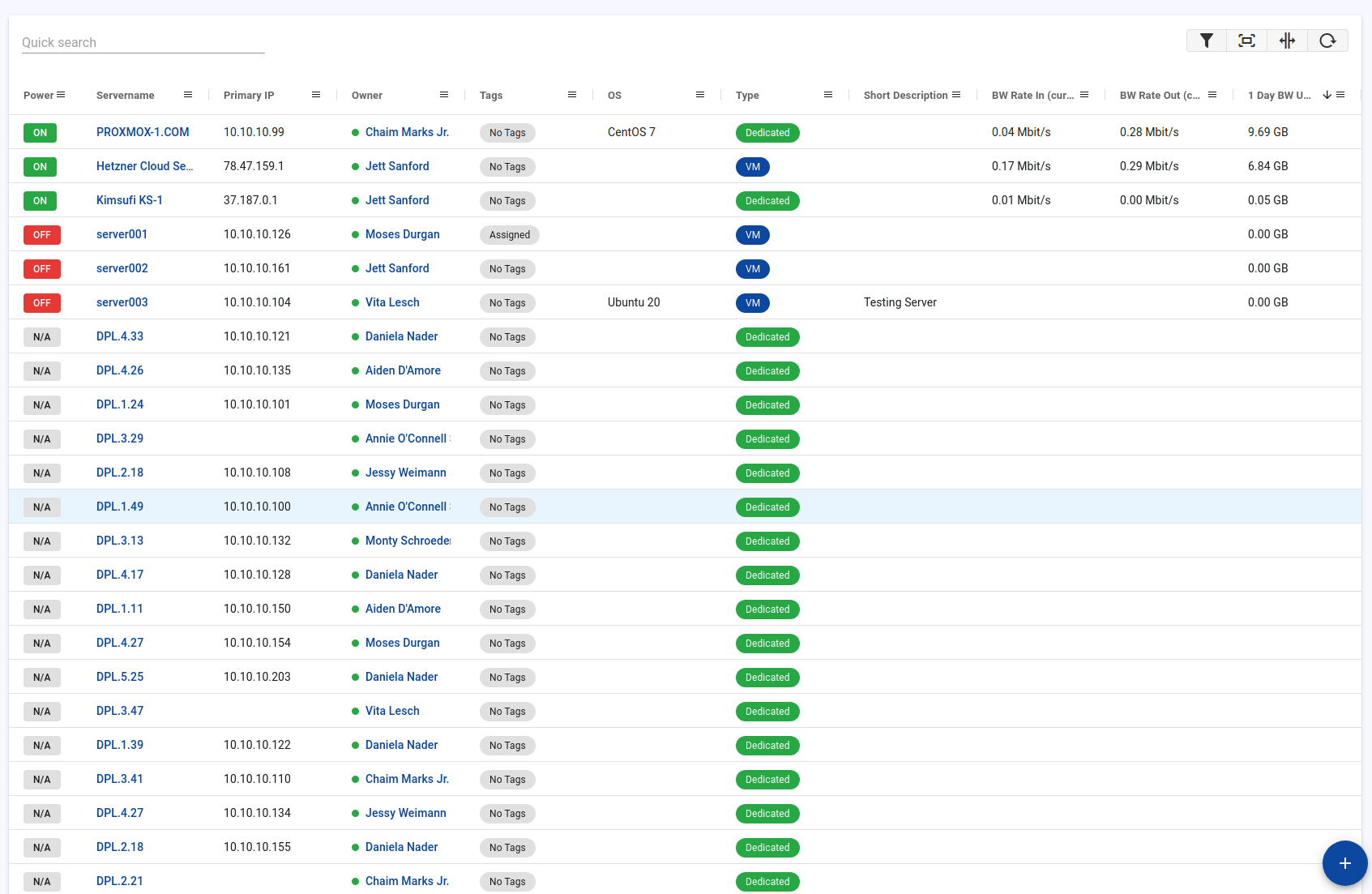
With support for NoVNC IPMI-KVM, IPMI power management, PXE OS reloads, and much more.
Proxmox and VMware are supported out of the box. Create VPS plans to automatically deploy new servers.
Resell servers from multiple providers (Hetzner, OVH) and provide your clients a single interface to manage all their servers in a unified panel.
Your resellers can work directly in your installation, with their own brand, customers and permissions. They can also run their own Tenantos and add yours as a provider, alongside their own hardware and other Tenantos providers. Features like power control, reinstalls and consoles simply work through the entire chain.
Even a server from an external provider like OVH or Hetzner passes through every level and looks like any other server to the customer at the end.
You can create reseller accounts and choose exactly which permissions the resellers should have. There are over 5000 permissions available, divided into three clear groups with about 100 subgroups each. Roles help you organize the permissions, so you define a set once and assign it to any number of accounts.
You can provide your resellers with the same free modules you use for the billing systems. Since Tenantos provides a unified API, the modules work the same way for every account and every service, whether it is a bare metal server, a VPS or a server from an external provider.
Depending on the permissions, your resellers can create their own customers and also create reseller accounts. This works on an infinite number of levels, so your resellers' resellers can also create resellers in turn. New resellers automatically receive role templates for their customers and sub-resellers.
Your resellers can customize Tenantos according to their needs. Via the web interface, they can add their own domains, change the language files or adapt the color scheme to their brand. When a reseller adds a domain, the web server configuration and the SSL certificate are handled automatically.
Your customers can reinstall the operating system at the push of a button. Depending on the type of server, the installation is done via PXE or via the API of the external provider.
Tenantos is able to automatically install a suitable RAID (1/5/10) depending on the number of available hard disks. In addition to Auto RAID, the customer can choose which RAID level to use.
You can create disk layouts and shell scripts that will be executed after the OS installation and limit them to servers with certain tags or to certain OS profiles.
Our proxy system allows customers to securely open an IPMI KVM console. The KVM console is opened in the browser without the need to install old versions of Java locally. You can leave IPMI in a secure, private network.
You can manage multiple sites from a central web interface. Just install an agent at the location, and Tenantos will do the rest. You can specify in the web interface which agent should be used to access the servers or network device.
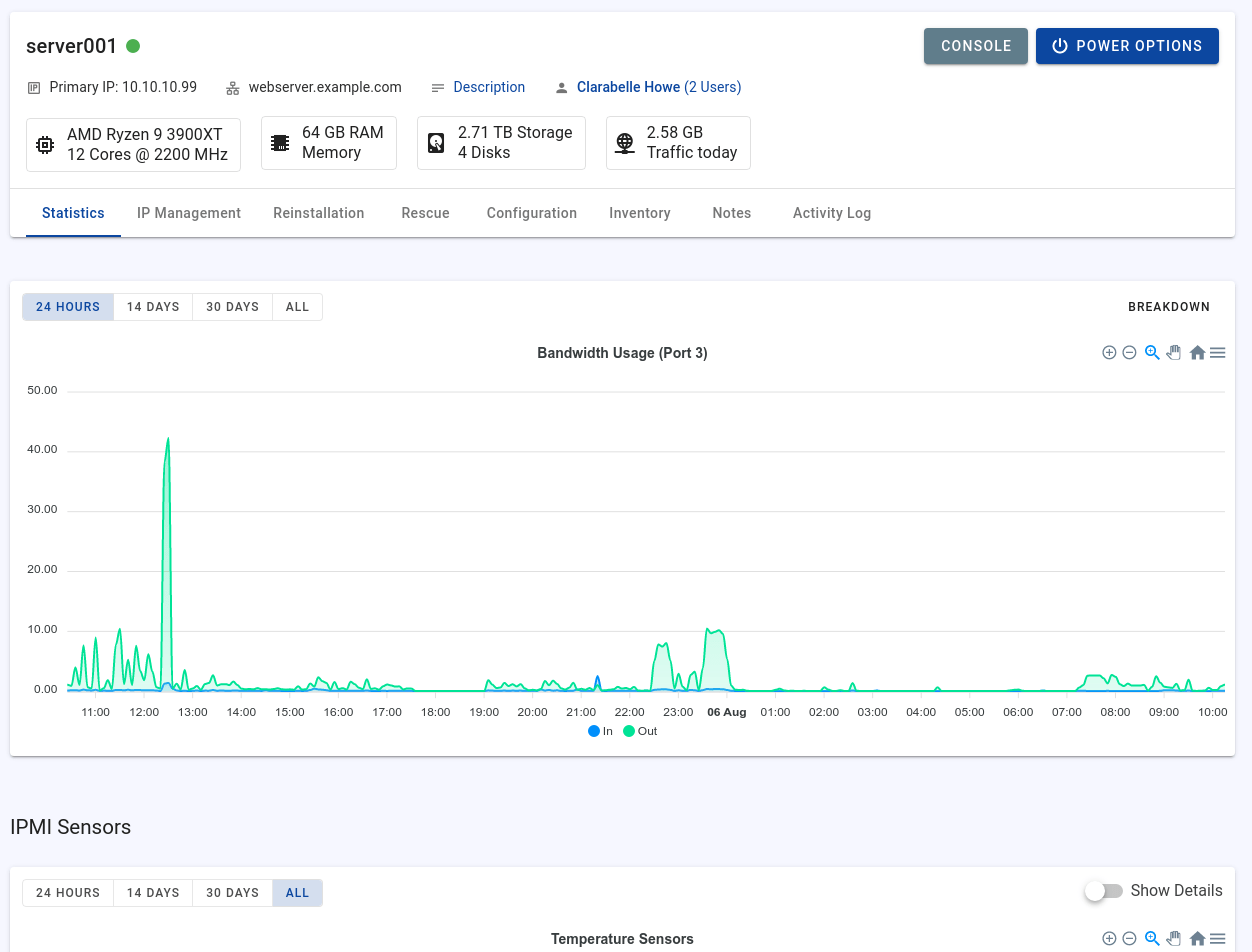
You can add SNMP switches and assign the ports to the servers. Tenantos collects the traffic consumption data and creates statistics from it. Of course, this also works for external providers and virtual servers.
Automatic hardware inventory for your servers via PXE boot or execution of a one-line shell command. You can also manually add or change the inventory data of each server.
Tenantos creates nice graphs of bandwidth usage, IPMI sensors and server power consumption (Watt & kWh). Even long time periods can be queried at blazing speed, thanks to InfluxDB and Redis.
Tenantos can configure your switches automatically: When a subnet is assigned to a server, the VLANs are created and assigned to the switch port. Vendors like Juniper, Cisco, Arista and Dell are supported.
Switched PDUs from APC, Raritan, Server Technology, CyberPower, Vertiv and other vendors can be assigned to servers, either as the primary power control or as a fallback if IPMI is unavailable.
The built-in IPAM keeps track of your IPv4 and IPv6 subnets, assigns IPs automatically during provisioning and lets you and your customers manage reverse DNS entries.
Tenantos is kept absolutely white label. There is no backlink or branding by us. Even the billing modules are kept white label so that it looks to your clients and resellers as if Tenantos were an in-house development.
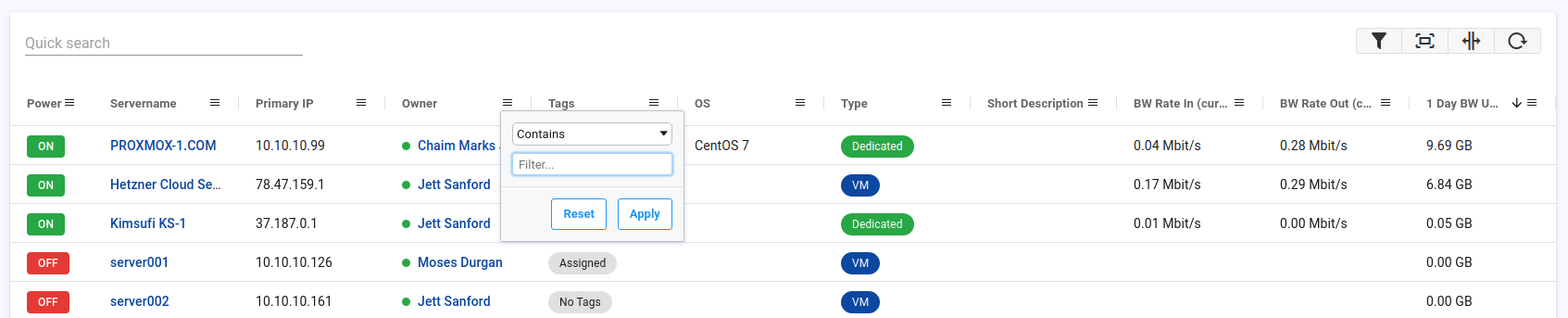
It is our concern that Tenantos users quickly find the things they are looking for. The quick search bar with real-time search, which is accessible on every page, helps you do this.
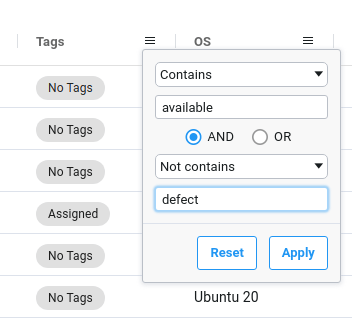
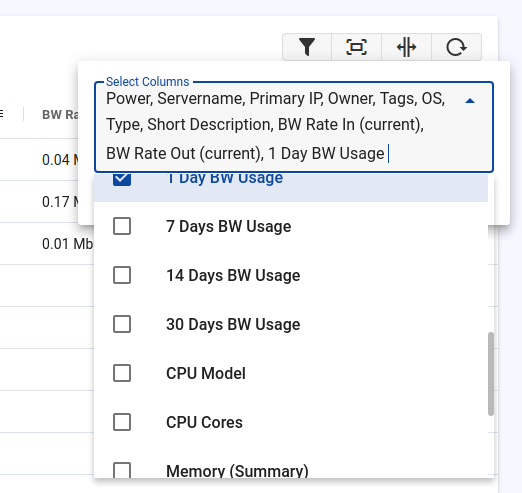
In addition to the quick search bar, each table is searchable and sortable. We have paid special attention to the server overview table, where you can search in any column, set multiple search conditions, and also add or remove individual columns. You can easily save your personalized overview table so that you can always see the things that are important to you at a glance.
One more thing about the server overview table: For a perfect overview, there are also columns available for the current bandwidth usage per server (Mbit/s), the traffic usage of the last 24 hours (7 days, etc.), and further columns like hardware details (CPU, disks, etc.). So you can quickly find out who is using the most traffic or if there are free servers with certain hardware parts.
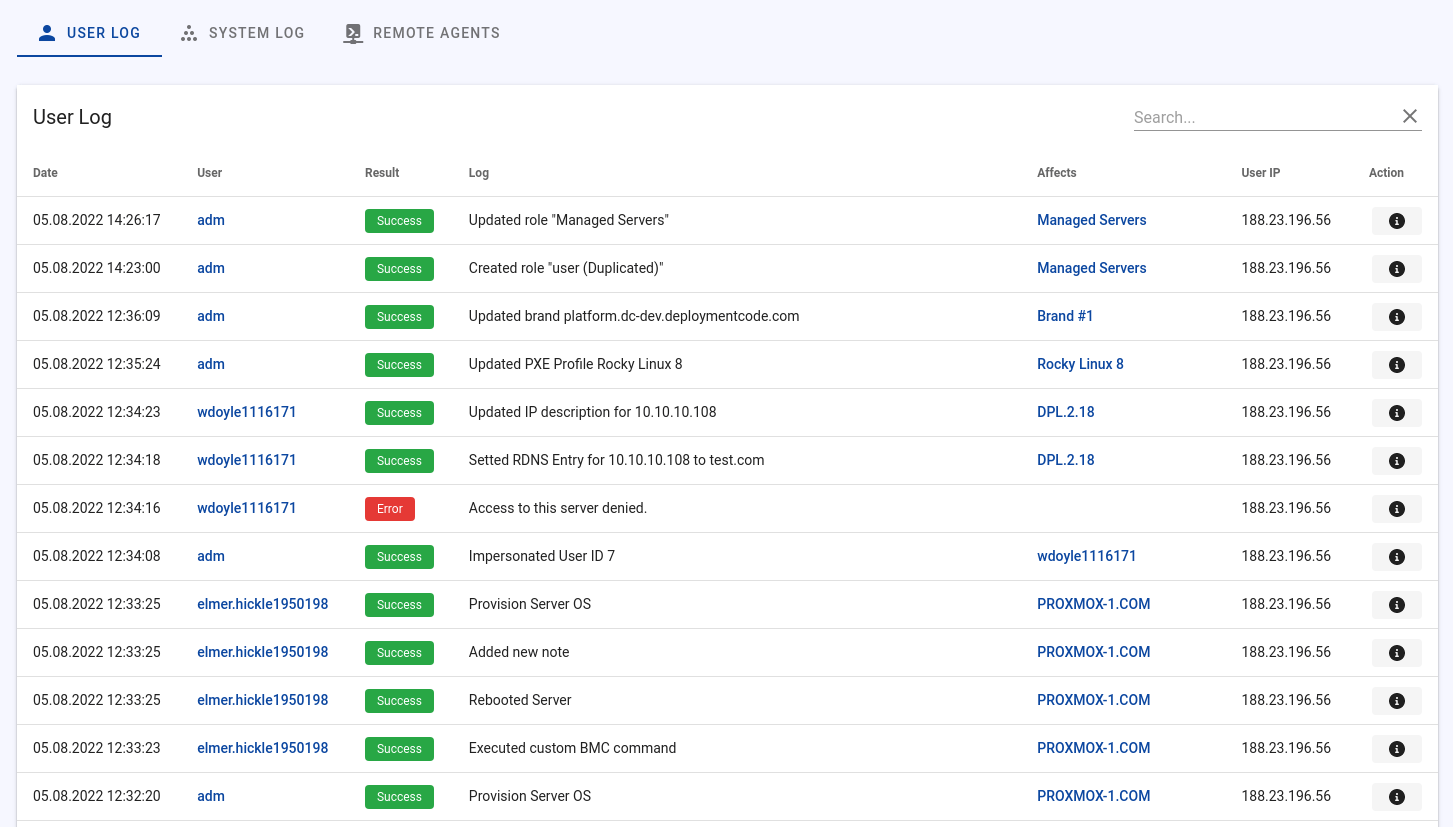
Tenantos logs every action and every API call. It not only records what action was done but also meta data like IP, user, user agent, the exact HTTP request, including request body, and other details. This makes it easy to determine afterward who did what.
You can also show the logs to your users and resellers. Of course, users only see the logs they are authorized to see.
If you have any questions, please feel free to contact us.
We will get back to you within a day, usually within a few hours.